
As many of you will know all too well, it is a constant source of frustration for residents and Councillors that many roads and open spaces in our new developments are not adopted by the Councils yet. Thus, we cannot pursue many issues such as the broken street lights, road signs, parking, etc., directly via the Councils.
Thus, Cllr Hauk moved a motion at Cambridge City Council‘s Full Council meeting on 16 July 2026, asking to improve transparency and accountability on new housing developments, helping residents understand who is responsible for roads, open spaces and other infrastructure, while ensuring we learn the lessons for future developments. It was unanimously accepted by the Council. Please read the original motion (it received minor amendments), and watch Cllr Hauk’s speech and the following debate. You can also read Cllr Hauk’s speech below.
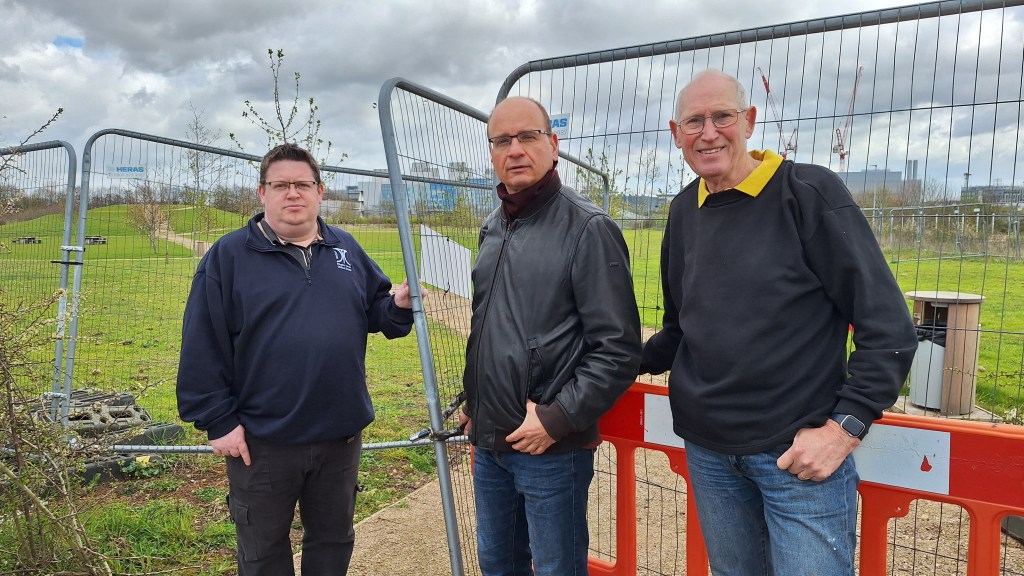
This motion followed years of action from local Lib Dem Councillors to sort out some of the long-standing issues around unadopted areas in Trumpington. For example, in November 2024, Cllr Hauk arranged an on-site meeting to discuss the plans for the Active Recreation Area in Hobson’s Park (Clay Farm area) with Councillors, Council officers, representatives of the developer Vistry/Countryside and the Biomedical Campus. It was agreed that the Active Recreation Area should open to the public by 1 April 2025. This date came and went, but the fences around the area remained. Cllr Hauk expressed his team’s frustration with the further delay and lack of communication from officers and developers to the Cambridge Independent, and That’s TV Cambridgeshire.
We regularly hear about broken street lights in the new developments, with some street having gone completely dark, as well as issues with street furniture and parking regulations, and keep pursuing them with the developers.
It’s complicated…
Below, we would like to share some general information about the adoption process from Council officers.
In short – it’s a complicated legal process. Unfortunately, Councillors are not always kept in the loop, and we regularly have to chase for information and updates. We are continuously keeping this on the Council’s agenda, whether in Council meetings, reporting issues to officers, raising publicity, etc. However, much of it is out of the control of local ward Councillors. I must also highlight the tireless effort of the Trumpington Residents’ Association, who for many years have pushed developers and the Councils to speed up the adoption process and mitigate the negative impacts of building works etc. Their newsletter (if you signed up) is a valuable source of information in this regard.
Finally, please keep reporting any issues in your area via one of the following links: https://www.cambridge.gov.uk/report-it. If they don’t know about it they won’t do anything about it.
—
The delivery and adoption of infrastructure on new developments is governed by several statutory processes and legal agreements. These involve many organisations and it may therefore be helpful to clarify how responsibilities are divided.
Planning and Developer Obligations
Planning permissions, conditions and Section 106 agreements are administered through the Greater Cambridge Shared Planning Service. Through the planning process, developers are required to provide infrastructure such as roads, open space, play areas and other facilities. Planning conditions and legal agreements set out what must be delivered and to what standard, but they do not normally control the detailed timing of adoption by public authorities.
Where a developer fails to comply with a planning condition or approved plans, the Shared Planning Service can consider the use of planning enforcement powers. However, enforcement powers are generally limited to breaches of planning control and cannot normally be used simply to accelerate the adoption of infrastructure where the works themselves are still progressing or awaiting technical approval.
Adoption of Highways
The adoption of roads, footways, street lighting and other highway infrastructure is the responsibility of Cambridgeshire County Council as the statutory Highway Authority. Adoption normally takes place through agreements under Section 38 of the Highways Act, once the developer has constructed the works to the required standards and the County Council is satisfied that they are suitable to become part of the public highway network. Issues relating to parking restrictions, traffic management and highway safety also fall within the County Council’s remit.
Adoption of Open Spaces
Where public open spaces, play areas or landscaping are intended to transfer to the City Council, this takes place through the relevant Section 106 agreement or other transfer arrangements. The City Council will only agree to adopt these areas once they have been completed to the agreed specification and are in an appropriate condition to be maintained as public assets. Until that point, responsibility for maintenance remains with the developer or their management company.
Developers
It is also important to recognise that on large strategic developments, developers remain responsible for the management and maintenance of infrastructure for a period while the scheme is still being built out.
Developments such as the Southern Fringe represent a significant undertaking and have been delivered over a long period, with build-out phases extending over 10 years or more. During this time, developers typically retain responsibility for the upkeep and management of newly installed infrastructure until it is ready to be formally transferred.
Most developers therefore maintain customer care teams and site management teams who are available to respond to issues raised by residents while the development is still progressing. The maintenance of newly installed infrastructure — such as roads, landscaping, play areas and lighting — normally remains the responsibility of the developer or their management company until the relevant authority agrees to adopt the asset.
The formal transfer of assets to public bodies is largely a technical and administrative process that takes place behind the scenes, once works have been completed to the required standard and the relevant inspections and approvals have been completed.
Cllr Hauk’s speech to support his motion at Full Council
Madam Mayor,
I would like to start by thanking officers for providing some very valuable advice on this motion at earlier stages. I’m also grateful to Cllrs Moore’s and Flaubert’s supportive amendments. And finally, I am grateful to the chair of the Trumpington Residents’ Association, Jenny Blackhurst, as well as previous Cllr Slatter, for sharing their experiences in their public questions, which show why this motion is necessary.
When I talk to residents in the new developments of Trumpington, the most frequent response I get is: “We are happy here”. I hope this is what my colleagues hear in every ward in Cambridge, because this is how it should be.
But being happy where you live should not mean accepting avoidable frustrations when things go wrong. Residents rightly expect their elected councillors to speak up on their behalf, to hold organisations to account, and to work together to make their neighbourhoods even better. This is what this motion is about.
This is not the first time I have stood in this chamber to speak about the problems residents face on Cambridge’s new developments. Over the past five years, you have heard me raise these issues time and again.
Clearly, simply raising these issues has not been enough. It is time for the City Council to do something more substantial within the powers available to us.
As a resident of a new development, you encounter broken street lights and street furniture, missing or confusing signage, uncertainty over parking rules, you notice dying trees, problems in open spaces and playgrounds and with other local amenities.
If there’s somethin’ weird, and it don’t look good – who you gonna call? … You don’t know, because you first have to find out who owns these areas. Sometimes it really feels like we’re hunting ghosts.
Residents quite rightly come to their local councillors for help, and of course we do everything we can. In my ward, Lib Dem Councillors have organised meetings with council officers, developers and residents’ associations, pursued countless cases and repeatedly raised these issues in this chamber.
But too often we have to explain to our residents that, because these estates remain under private ownership, the councils are not responsible for many of the day-to-day issues.
Too often, we are left saying to residents: “I’m sorry, but there isn’t much else the Council can do”.
Unlike for council services, we don’t have direct access to officers, service managers or formal procedures with developers to investigate problems and get action taken.
While we have managed to resolve some issues through persistence, far too many drag on for years. For example, the first residents moved into Clay Farm around ten years ago. A long-promised playground only opened last year. The Active Recreation Area at Hobson’s Park is still fenced off despite repeated promises that it would open soon. Some streets are completely dark at night because street lights have not been fixed, and residents continue to face uncertainty over parking arrangements.
Crucially, these examples do not simply demonstrate poor communication or slow delivery. The fundamental problem is that public services are expected to be publicly accountable.
Residents on these estates pay exactly the same council tax as everyone else in Cambridge, yet often receive fewer public services because essential infrastructure remains in private hands. Many are also paying estate management charges on top. It is no surprise that residents ask why they are paying more while getting less. That simply isn’t fair.
Residents elect us to represent them and to solve problems. Normally, when something goes wrong with a public service, there are clear lines of responsibility. Councillors can work with officers, escalate issues and ensure residents receive answers, if not solutions.
But on many new developments responsibility is fragmented between developers, management companies, contractors, sub-contractors, landowners and public bodies. Residents often do not know who is responsible. The only route often is a just a generic customer service inbox.
We lack the powers, access to information and officer support that we have when dealing with council services. As a result, issues that should take weeks can end up in the long grass.
That is precisely what this motion seeks to address. The motion is practical. It sets clear expectations for developers. It aims to create named points of contact, improve communication with residents and councillors, and it asks the Council to explore embedding these standards into future planning procedures. And we need to know whether, when and how areas in the new developpments will be adopted by the Councils.
This motion calls on this Council to take practical steps now to improve the experience of residents on existing developments, while acknowledging its limited powers.
But it is not just about today’s residents. It is also about the thousands of people who will move into new neighbourhoods over the coming years, including North and East Cambridge.
If, as currently proposed, the Development Corporation grabs planning responsibilities for larger developments, then the Council must make a clear and compelling case that transparency, accountability and resident engagement are established from the outset, so that future communities do not inherit the same problems.
Cambridge needs new homes. But new homes must come with accountability. Residents should not have to wait more than ten years for promised facilities. They should not spend years wondering who is responsible for fixing basic problems. And councillors should not have to tell them, “I’m sorry, but there isn’t much more we can do.”
This is why I ask you to support this motion.

